Study in India: From a Leading Source Market to a Global Education Destination
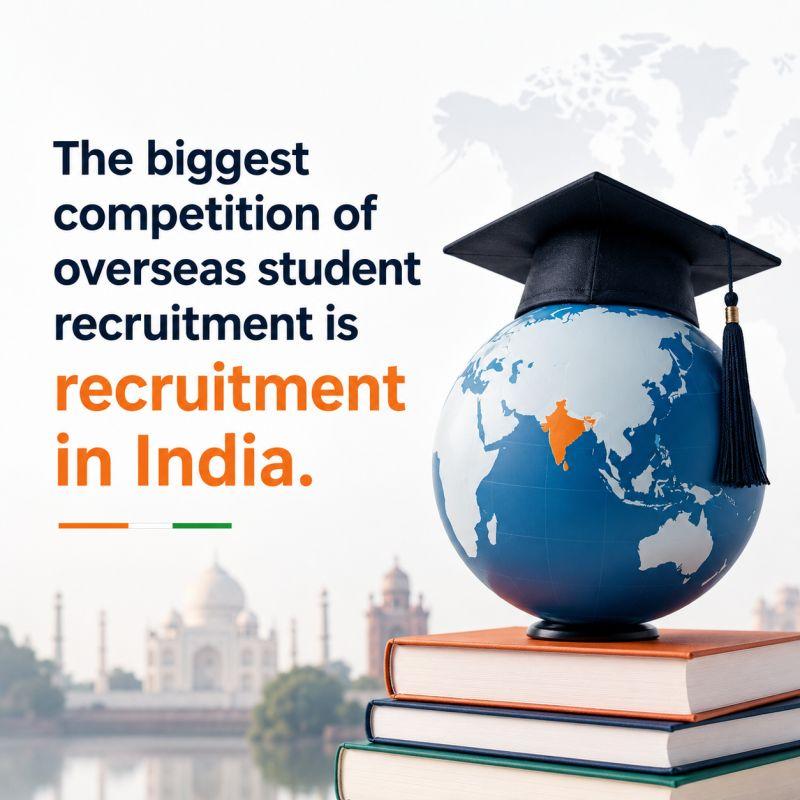
🌍 The biggest competition in international student recruitment may no longer be another destination country—it could be India itself.
Study in India is becoming an increasingly attractive option for international students around the world. For decades, India has been known primarily as one of the world’s largest source markets for international education.
For decades, the international education landscape has largely followed a familiar pattern. Countries such as the UK, Australia, Canada and the USA have competed to attract talented Indian students, with India consistently remaining one of the world’s largest and most important source markets.
But the dynamics of global student mobility are beginning to change.
India is no longer just sending students abroad. It is increasingly positioning itself as a destination for students from around the world.
According to the latest AISHE data, India welcomed 58,134 international students from 173 countries during the 2023/24 academic year, representing an impressive 19% increase compared with 2019/20. Nepal continues to be the largest source market for international students coming to India, while Karnataka has emerged as the leading destination state.
These numbers may still be modest compared with some of the world’s largest international education destinations, but the direction of travel is significant.
India has several advantages that could make it an increasingly attractive choice for international students over the coming decade.
🎓 Affordable quality education: Compared with many traditional study destinations, India can offer internationally recognised programmes at a significantly lower cost. For students and families increasingly concerned about tuition fees and the overall cost of living, affordability is becoming a major decision-making factor.
🌏 A growing global reputation: Indian institutions are strengthening their international presence through improved rankings, research output, global partnerships and collaborations with universities worldwide. The growth of internationally recognised institutions, specialised programmes and emerging centres of excellence is helping reshape perceptions of Indian higher education.
🤝 International collaborations: More Indian universities are developing partnerships, exchange programmes, dual degrees and research collaborations with institutions across the world. This internationalisation is making the Indian higher education ecosystem more connected and attractive to global students.
📚 The impact of NEP: The implementation of the National Education Policy is also contributing to a transformation in India’s higher education landscape. Greater flexibility, interdisciplinary learning, international partnerships and a stronger focus on globalisation could make Indian institutions increasingly relevant to international students.
🌐 A strategic location: India also has the potential to attract students from neighbouring countries, South Asia, Africa, the Middle East and other emerging markets. For many students, India offers geographical proximity, cultural familiarity, affordable education and access to one of the world’s fastest-growing economies.
This creates an interesting new reality for universities and education agents worldwide.
For years, the focus has largely been on one question: How can universities attract more Indian students?
Perhaps another question is now becoming equally important:
How will international universities compete when Indian students have stronger and more attractive opportunities at home?
The competition for students is no longer simply between the UK, Australia, Canada, the USA and Europe. Increasingly, students may compare international opportunities with high-quality and affordable options available within India itself.
This does not necessarily mean that fewer Indian students will choose to study abroad. International education will continue to offer valuable benefits such as global exposure, specialised programmes, international careers and cross-cultural experiences.
However, the decision-making process is becoming more competitive.
Students now have more choices than ever before.
They are comparing cost, quality, employability, post-study opportunities, immigration policies, safety, return on investment and career outcomes. Universities across the world can no longer rely solely on India’s large student population. They must clearly communicate the value and outcomes of an international degree.
At the same time, India has a significant opportunity to build its identity as a global education hub.
If institutions continue to improve quality, student experience, internationalisation, research and global employability, India could emerge as one of the world’s most important destinations for international students over the next decade.
The global student recruitment landscape is changing rapidly.
India has traditionally been one of the world’s biggest sources of international students.
Could it now become one of the world’s leading destinations too?
🌍 What are your thoughts? Will India become a major global international education destination over the next decade?
#InternationalEducation #StudyInIndia #HigherEducation #StudentRecruitment #GlobalEducation #InternationalStudents #India #StudyAbroad #Education #NEP