UK RAG System for Universities: New BCA Rules, Visa Limits & Recruitment Changes
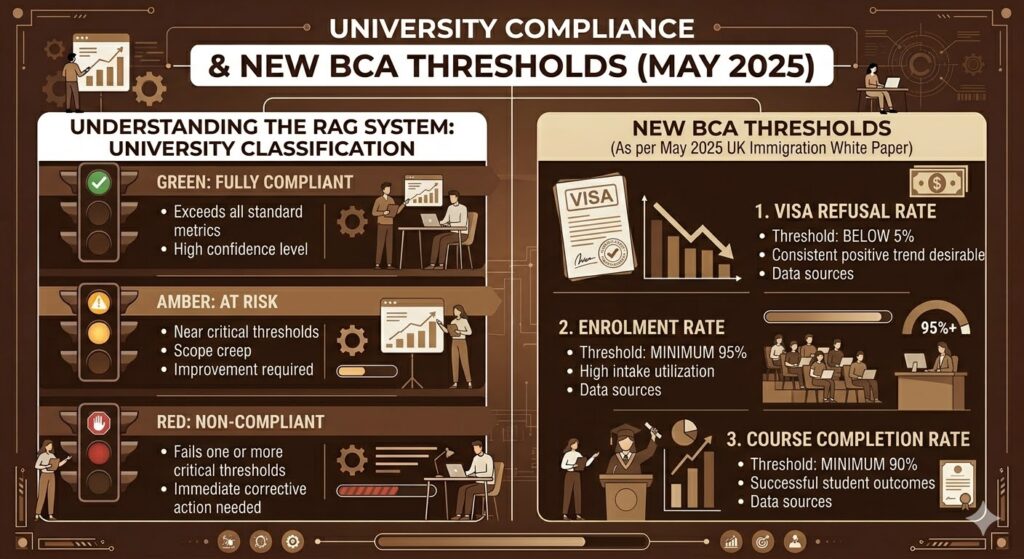
UK RAG system for universities is set to redefine the landscape of international student recruitment, introducing stricter compliance standards and a new risk-based classification framework for institutions across the United Kingdom. Announced as part of broader immigration reforms, this system reflects the government’s growing emphasis on accountability, transparency, and quality in higher education.
With new Basic Compliance Assessment (BCA) thresholds and a Red-Amber-Green (RAG) rating mechanism, universities will now be evaluated more rigorously on visa refusals, enrolment rates, and course completion outcomes. These changes, rolling out from June 2026 and June 2027, are expected to significantly influence how institutions recruit, assess, and support international students.
Understanding the Regulatory Background
To study in the UK, international students must first obtain a Confirmation of Acceptance for Studies (CAS) from a licensed sponsor institution. This document is essential for applying for a student visa and represents the institution’s assurance that the student is genuine, eligible, and capable of completing their course.
This responsibility places significant accountability on universities. Institutions must undergo a Basic Compliance Assessment (BCA) every year to retain their sponsor license. Failure to meet compliance standards can result in sanctions—including the most severe outcome: revocation of the sponsor license, effectively preventing the institution from enrolling international students.
Until now, the BCA has been based on three core metrics:
- A visa refusal rate of less than 10%
- An enrolment rate of at least 90%
- A course completion rate of at least 85%
These benchmarks ensure that institutions not only recruit eligible students but also admit those who are likely to enroll and successfully complete their studies.
The New BCA Thresholds: Raising the Bar
In May 2025, the UK government released an immigration white paper outlining stricter compliance expectations. These new thresholds significantly tighten the margins for universities:
- Visa refusal rate must be below 5%
- Enrolment rate must be at least 95%
- Course completion rate must be at least 90%
Implementation will take place in phases:
- 1 June 2026: New visa refusal and enrolment thresholds come into effect
- June 2027: Course completion threshold increases from 85% to 90%
These tighter requirements reflect a clear policy direction: reducing visa misuse, improving student outcomes, and ensuring that only genuine students enter the UK education system.
Introducing the RAG System
One of the most significant additions to the compliance framework is the Red-Amber-Green (RAG) rating system. This system categorizes universities based on their performance against BCA metrics:
- Green: Fully compliant and comfortably within thresholds
- Amber: At risk of falling below compliance
- Red: Non-compliant or below required standards
While this may appear straightforward, the operational design of the RAG system introduces new complexities and pressures.
A Critical Twist: Lowest-Metric-Wins
Unlike traditional scoring systems, the RAG rating is not based on an average across metrics. Instead, a university’s rating is determined by its lowest-performing metric.
For example:
If a university performs well in enrolment and completion but exceeds the visa refusal threshold, it will still receive a Red rating.
This “lowest-metric-wins” approach dramatically increases the stakes for institutions. Even a minor underperformance in one area can overshadow strong results elsewhere.
Extremely Narrow Margins for Error
Another defining feature of the RAG framework is the narrow range between compliance bands.
The difference between Green, Amber, and Red is often just 1–2 percentage points. This leaves very little room for natural fluctuations in student behavior or external factors such as visa processing delays or economic challenges.
In practical terms, this means:
- A slight increase in visa refusals could push an institution into Red
- A small drop in enrolment rates could trigger compliance risks
- Minor variations in completion rates could have serious consequences
This tight margin is expected to make compliance management significantly more challenging.
Public Disclosure of RAG Ratings
Adding another layer of accountability, the UK government plans to publish RAG ratings for all sponsoring institutions.
These ratings will appear on the official student sponsor register and are expected to become publicly available after the first full assessment cycle post-June 2026—likely by mid-2027.
Public disclosure introduces reputational risk. Institutions will not only need to maintain compliance but also protect their global image among students, partners, and stakeholders.
Impact on International Student Recruitment
The introduction of stricter thresholds and the RAG system is expected to have far-reaching implications for recruitment practices.
1. More Selective Admissions
Universities will likely adopt stricter screening processes before issuing CAS. This may include:
- Enhanced academic verification
- Stronger financial checks
- Deeper evaluation of English language proficiency
- Credibility interviews
The goal is to ensure that only students with a high probability of success are admitted.
2. Increased Focus on “Low-Risk” Markets
Institutions may prioritize recruitment from countries with historically lower visa refusal rates and higher completion rates.
Conversely, recruitment from “high-risk” markets may be reduced or even suspended. Some universities have already taken such steps in response to rising compliance pressures.
3. Reduced Access for Genuine Students
While the intention of the policy is to maintain quality, it may inadvertently limit opportunities for legitimate students.
Applicants from certain regions may face stricter scrutiny, longer processing times, or reduced admission chances—even if they are genuine candidates.
4. Higher Administrative Burden
Compliance under the new system will require:
- More data tracking and reporting
- Enhanced internal monitoring systems
- Dedicated compliance teams
- Increased collaboration with recruitment partners
These changes will inevitably increase operational costs for institutions.
Real-World Institutional Responses
Even before full implementation, some universities have already begun adjusting their strategies:
- Limiting recruitment from specific countries with high visa refusal rates
- Reducing reliance on certain agent networks
- Tightening admission requirements
Such measures highlight the growing importance of risk management in international education.
Balancing Quality and Accessibility
The rationale behind the new system is clear: to ensure that universities recruit genuine students who are prepared to succeed academically.
Stronger compliance can:
- Protect the integrity of UK education
- Enhance student outcomes
- Maintain the UK’s global reputation
However, the framework also raises important concerns:
- Over-regulation: Institutions may become overly cautious
- Reduced diversity: Fewer students from emerging markets
- Equity challenges: Genuine students may be unfairly disadvantaged
The challenge lies in balancing quality assurance with inclusivity.
What This Means for Education Consultants
For consultants and recruitment partners, the new system will require a shift in approach:
- Greater emphasis on student profiling
- Transparent and ethical recruitment practices
- Stronger documentation support
- Clear communication with partner universities
Consultants will play a critical role in helping students meet the higher standards expected by institutions.
What Students Should Expect
International students planning to study in the UK should be prepared for:
- More rigorous admission processes
- Increased documentation requirements
- Higher expectations for academic and financial readiness
Students will need to demonstrate not only eligibility but also intent and capability to complete their studies successfully.
The Road Ahead
The UK government is currently engaging with stakeholders across the education sector, and final guidance is expected soon. While some adjustments may still be made, the direction is clear: a tighter, more accountable system for international student recruitment.
As implementation approaches, institutions, consultants, and students alike must adapt to this evolving landscape.
Conclusion
The introduction of the RAG system and stricter BCA thresholds marks a significant turning point for the UK’s international education sector.
While the framework aims to strengthen compliance and protect academic standards, it also introduces new challenges—particularly around recruitment practices, accessibility, and institutional risk.
Ultimately, the success of this system will depend on its ability to strike the right balance between rigour and fairness.
For now, one thing is certain: the era of volume-driven recruitment is coming to an end, replaced by a more strategic, quality-focused approach to international student admissions in the UK.